Showing posts with label Exhibition. Show all posts

Wednesday, 18 April 2012

DAVID HOCKNEY: A Bigger Picture, Royal Academy London

Hockney's diverse style has always been influential to my work I am intrigued by his range of artistic methods and find that I learn....

I had visited the Salt Mill in Yorkshire a couple of years ago and experienced his prints and paintings first hand for the first time. My favourite were the unusual and child like "Brothers Grimm" etchings. I loved their simplicity and the different textures.
The salt mill visit and my entire trip to yorkshire told me a lot about Hockney's beautiful yet humble surroundings.
Compared to Hockney's latest exhibition at the Royal academy, the salt mill exhibition was much more intimiate and modest. However I was not disappointed with the standard and the large quantity of work on display.
Hockney, despite being in his 70's, is still evidently producing a vast amount of work.
It was a huge collection of drawings and paintings from the last ten years or so of the Yorkshire countryside in a place called Bridlington.
My first initial thought when i stepped into the gallery was that there was a lot of trees...There wasn't much variation of the subject matter.

In the first room was a collection of his earlier landscapes (from 1956-1998) and I think this was my favourite part of the exhibition. It introduced us to his "representation of space." Instead of describing the visual aspects of space such as light or perspectives, in works such as "Flights into Italy- Swiss Landscape"1962 he illustrates the raw memory of his travels through the swiss Alps. The painting showed a small roughly drawn van with two figures squashed inside, driving through colourful abstract mountains. Apparently, Hockney was stuck in the back of the van so was unable to see much on the journey so Hockney used a geology book to draw from. The scribbled quote I found that his semi-flippant way of working much more modest and interesting than the other work in the exhibition. Hockney painted "Flights into Italy" just after he graduated at the Royal Academy and first got the opportunity to travel so there is a sense of freedom and excitement demonstrated in the use of colour and mark making.

This allusive demonstration of a space or experience was very inspiring.

I then began to explore the rest of the exhibition and understand Hockney's devotion to his work.
This included over a 150 paintings of the same places that Hockney continuously revisited during different times of the year.
The paintings were vibrant and colourful, vast and exuberant; some of them made up of 24 canvas's and were over 6 metres height.

Despite the initial enthralment by the sheer scale of some of the pieces, I was more drawn to the charcoal drawings and water colours he used as a reference to these paintings. They were much more informative and quietly intricate than the loud paintings. The subtle watercolour tones were much more informative and the use of charcoal captured light and shadow in a way that fluorescent pink or any other vibrant oil paint could never do. They were done directly from observation and demonstrated a much more raw and skilful depiction of a space.
The works were done after the release of his book: "Secret Knowledge: Redirecting the lost techniques of the Old Masters," an investigation into optical devices used in art throughout history. "He states that the camera has had a huge huge impact on the composition of paintings since they were introduced. "Hockney deliberately rejects the cameras influence and limited view". The book along with his watercolours demonstrate the importance of recording from observation.

You can also get an idea of the intelligent way that Hockney paints by looking at his iPad paintings.

It was a very odd experience...You got a good idea of how a painting is created as the brushstrokes and layers of colour were much more visible.  However, there was no texture or surface as it was merely a composition of digital layers.
The wasn't anything real about the "painting." One of my favourite things about paintings is the paint itself. I love the texture and the unpredictable behaviour of paint and the fact that you can see the mistakes or smudges to understand the evolution of a painting. It is impossible to reinvent the same behaviour in these "iPaintings" however it is a stark reminder of the possibilities of technology and how it seems to reach into every aspect of our lives.

All in all I found the exhibition very interesting and informative however I thought it was slightly ostentatious.
Despite my skepticism of the exhibition, I appreciated Hockney's skill and devotion to the his work and he is still an artist that I admire and his work remains a solid influence to my own.

Monday, 9 April 2012

George Condo: Mental States


JAN 2012


I was familiar with condos work before I visited the exhibition in January but never understood his classical influences and his obsession with portraits.
In an article in the times he states that he uses the classical painting methods of Michael Angelo and Rembrandt to create starkly modern images.

I went on my own and the gallery was almost empty. Which was perfect,  I had him all to myself!

I was introduced to a line-up of bronze heads, each telling a different emotional story.


Some were frightening, some were odd but despite this I felt a sense of empathy towards these beings. Condo, although better known as a painter, has been making sculptures throughout his artistic career. The heads displayed are imaginary portraits of tragedy and woe and refer to Greek sculpture. Some had a recognisable reference to Greek sculpture and some faces were completely characterised it was almost comical.

Condo states that the reason for creating these characters was to “create the illusion of excavated buried treasure, as if these were relics of a lost civilisation.”

This is what I want to create when I draw from my imagination and this quote is such a beautiful way of putting it.

It stated in the booklet, that “Condo has focused on reconfiguring our basic ideas of portraiture

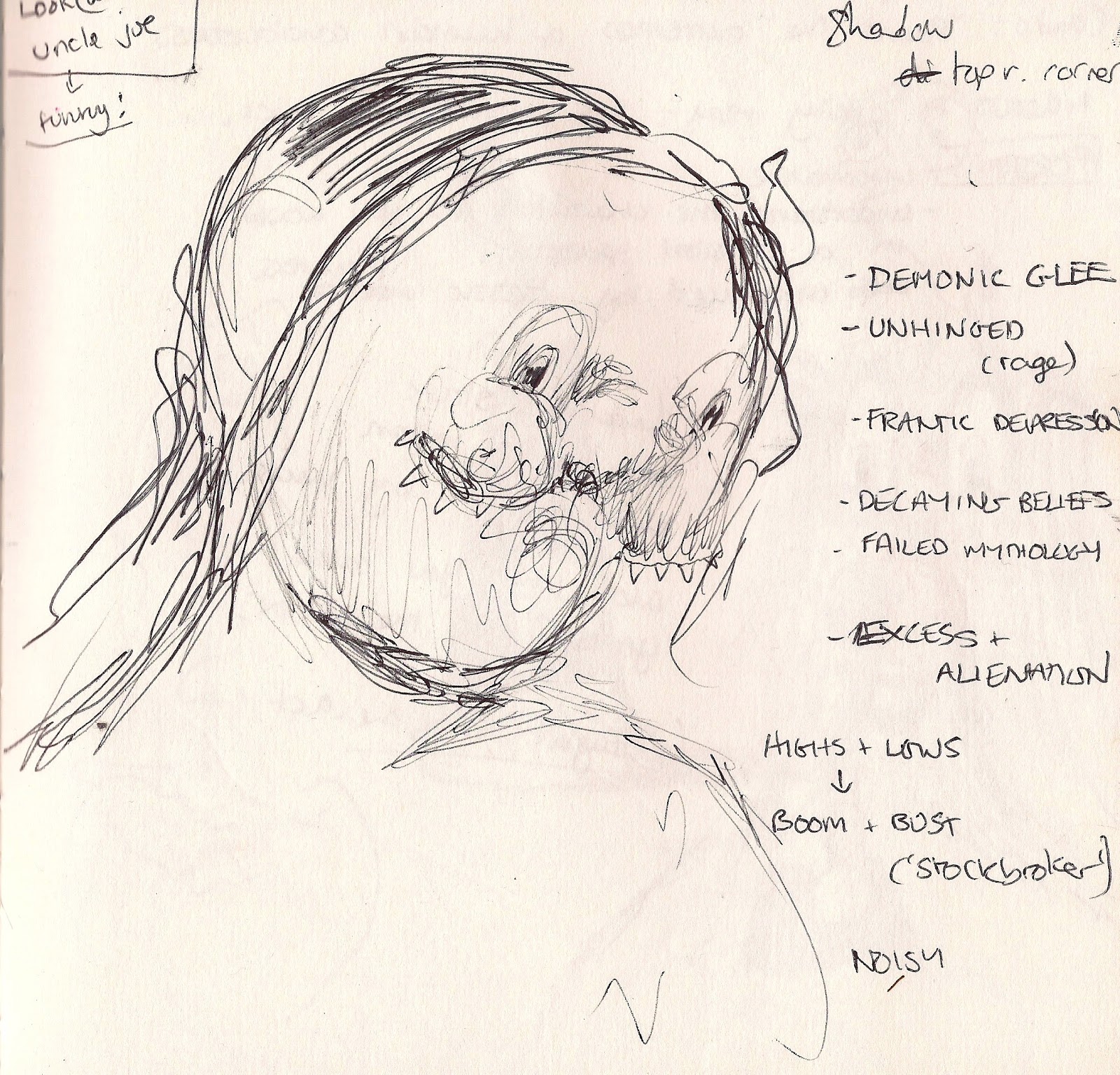
Every single character had a story to tell and although their extended limbs, protruding chins and fanged grins were completely imaginary, the characters were utterly real. They all had a strange demonic glee about them.


Their faces were unhinged and frightening yet I felt almost related to them. Their stare is as though they have been caught in the act. I couldn’t put my finger on it but I felt as though they reflected a part of myself. Some strange disassociated common ground. Walking past the portrait was as though you were catching a glimpse of yourself in the mirror. Perhaps his understanding of classic painting made his portraits so alive.

However Condo states that some of his works such as Aldous Huxley “come from the minds antipodes, where objects do not stand for anything but themselves.”


I feel I can relate my work to this as sometimes I draw things that are a compilation of things that are solely from my imagination. When I look at it afterwards I can’t understand where some of the imagery has come from and it produces an image that doesn’t represent or identify anything but the image itself gives it a purpose.

I found condo’s work immensely inspiring. There was so much to learn and think about. I learned a lot about his techniques as well.

 
Seated Nude
George Condo 2005
                                

I noticed condo’s characters seemed to stand or sit in a void of colour.. I often draw onto a blank space and my drawings seem to float and aren’t contained on the page very well.  I wanted to learn how condo housed his creatures. In one painting, [See above, “Seated Nude” 2005]  an eerie bug-eyed being sits hunched on the floor, his neck and limbs extending across canvas. I noticed condo had added a shadow that went from left to right. I thought this is a good method of creating depth to a background and I will probably steal that idea.

Although Condo draws mostly from his imagination, real life plays an important role in his work.
He addresses subjects of melancholy, depression, excess and alienation and the highs and lows of modern life or “Boom and Bust”
Some his characters represent failed business men, alcoholics and tired relationships. Many of his characters are isolated within the canvas, reflecting the loneliness of the everyday working life. The starkly realistic gloom that emanates from the paintings is an awakening reminder of the difficulties of human consciousness. The solitariness and stillness in these paintings is very powerful and evoke a sense of empathy towards these sorrowful characters.

                                            
Dancing To Miles, 1985-86
George Condo

The section on Abstract Figuration was interesting but least inspiring to me. Condo depicted scenes of chaos that I found overwhelming.  They mirrored the chaos of everyday life, which was completely relevant to me as an resident of central London. It reminded me of how many faces you see everyday but do not process. From a distance the image was a blur and even close up it was difficult to distinguish a face or a person. It reminded me of how much your brain has to process during everyday consciousness and the many faces you see living in a busy city that you will never see or remember again.

The great thing about art is that you can see yourself without ever having to look in the mirror…Occasionally, real life is crazier than anything that can come from our imagination. You only have to look around you to see how nuts it can actually be.”


I got so much out of my visit to the exhibition. I found that Condo’s imaginary characters expressed a reality that I never understood before. Although they were from imagination there was something real about them that you couldn’t ever comprehend from consciousness. I have always had doubts from working from my own imagination but if I was to take inspiration from my own mental experiences my work would make more sense to an outside viewer.

My own george condo style character...

From this exhibition I have decided to create a personal project about my own experiences, whether conscious or sub-conscious and make a series of prints that represented my own little wonderland.

I will look at Lewis Carol’s Alice and Wonderland, and George Condo’s portraits and will include references to reality and fantasy, will pay with scale and perspectives to create scenes from my imagination.